The Earthing Protocol: How to Ground Yourself Indoors, and Whether It's Worth It

Earthing, or grounding, is the practice of putting your body in direct electrical contact with the earth. Barefoot on wet grass is the original version. Indoors, you do it with a conductive mat under your feet or a conductive sheet on your bed, wired to the ground port of your outlet. People report better sleep, less pain, calmer nerves. That is worth taking seriously. It is also worth being blunt about: the science behind all of this is thin, mostly small studies, and a lot of it comes from the people selling the mats.
This page is the whole protocol. How to set up, how long, how to progress, and how to confirm your gear is actually connected to earth instead of just sitting there looking like it is. Most people who try earthing and feel nothing were never grounded at all. Call it the placebo mat problem: a mat on a dead outlet is just a rug. Fixing that is a five-minute test, and it is the difference between running a real experiment and fooling yourself.
If you want the evidence laid out plainly, good and bad, start with does grounding actually work. That page is the reason this site exists. Most grounding content sells you certainty nobody has earned.
You will see two words used across this site: "earthing" and "grounding." They mean the same thing. Earthing is the term Clint Ober popularized in the books. Grounding is the everyday word and the electrician's word. I own earthingprotocol.com and groundingprotocol.com, and both point here, so I use whichever reads better in the sentence.
The Protocol in One Box
Where to start: a grounding mat under your feet at your desk, or under your bare feet on the couch. Cheapest way to test whether you notice anything.
How long: 30 to 60 minutes a day to start. Many people who stick with it move to sleeping grounded on a sheet, which is 6 to 8 hours a night of contact.
Skin contact is the whole thing: bare skin on the conductive surface. Socks, thick clothing, and lotion all break the connection. It is not a vibe, it is a circuit.
The one non-negotiable: confirm your outlet is actually grounded before you trust any of this. A mat plugged into an ungrounded outlet does nothing at all. Here is how to check in five minutes.
Before you start: if you take blood thinners, have a pacemaker, or are pregnant, read the safety page and talk to your doctor first.
Get the 1-page protocol + the 5-minute grounding test
The setup, the skin-contact rules, the safety cautions, and the test that proves your gear is actually grounded. One sheet you can print and keep by the bed. Free.
Send me the free protocol sheetWhy Do This Indoors at All
The original claim is simple. For most of human history we were in skin contact with the ground: bare feet, dirt floors, sleeping on the earth. Modern life put rubber soles on our feet and wood, carpet, and concrete between us and the planet. The earthing hypothesis says that disconnection matters, and that reconnecting lets the earth's free electrons flow into the body and mop up the reactive molecules involved in inflammation. That is the theory. It is a clean, appealing story. Appealing stories are exactly the ones to be careful with, which is why the evidence page exists.
Outdoor grounding is free. Walk barefoot on grass, sand, or wet soil for 30 minutes. If you have a yard and warm weather, do that and skip the shopping. Indoor grounding gear exists for the other nine months of the year, for apartments, and for grounding while you sleep, which is where most of the real user reports come from. That is the honest case for buying anything: convenience and consistency, not magic in the wire.
The Protocol by Level
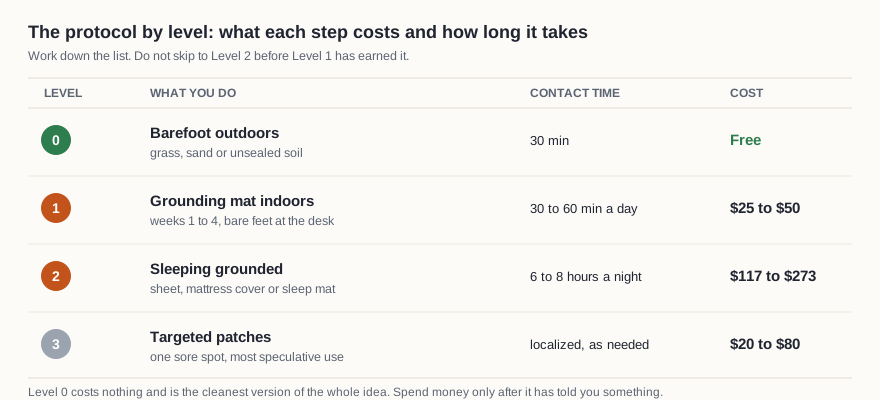
Level 0: Barefoot outdoors (free, start here if you can)
Thirty minutes of bare feet on grass, sand, or unsealed soil. Wet ground conducts far better than dry. Concrete works if it sits directly on the earth and is not sealed or painted. This costs nothing and is the cleanest version of the whole idea. Do it for a week or two and pay attention to whether you notice anything before you spend a dollar.
Level 1: A grounding mat indoors (weeks 1 to 4)
- Setup: a conductive mat under bare feet at your desk, or under your feet on the couch. Wired to the outlet ground.
- Time: 30 to 60 minutes a day while you work or relax.
- Contact: bare skin only. Feet, forearms, or hands touching the surface.
- The test first: before you trust it, confirm the outlet is grounded and the mat has continuity. This is the step almost everyone skips, and it is the difference between grounding and sitting on a placebo.
Our picks and prices are on best grounding mats. A real mat runs $25 to $50. You do not need a $700 one to test the idea.
Level 2: Sleeping grounded (the version people stick with)
- Setup: a conductive sheet or half-sheet across the fitted sheet where your skin will touch it, wired to ground.
- Time: all night, 6 to 8 hours of contact.
- Why this level: the most cited grounding studies, the Ghaly and Teplitz sleep-and-cortisol work, grounded people overnight. If any version of this does something, sleep is where the user reports are strongest.
- Contact: bare skin against the conductive threads. A shoulder, a calf, an arm. Full pajamas over the whole sheet defeats it.
Sheets run about $117 to $273, and there are cheaper non-sheet ways to sleep grounded. See best grounding sheets for the honest breakdown, including why the fiber material matters more than the brand.
Level 3: Targeted patches
- Setup: sticky conductive gel patches placed on a specific sore spot, wired to ground.
- Use: localized aches, a bad knee, plantar fascia. This is the most speculative use and the evidence is mostly anecdotal, so treat it as an experiment.
- Patches run about $27 for a generic 10-pack with a cord, up to $120 for 360 brand-name refills. Covered on the patches and testers page.
The Skin-Contact Rules (this is where people go wrong)
Grounding is an electrical connection or it is nothing. The most common reason someone tries earthing and feels absolutely nothing is that they never actually completed the circuit. Keep these straight:
- Bare skin, always. Socks block it. A shirt between you and the sheet blocks most of it. Lotion and heavy calluses reduce it.
- The outlet has to be grounded. Old two-prong wiring, a miswired outlet, or a cheater plug means zero connection. Test it.
- Dry skin conducts worse. A little humidity or slightly damp skin improves contact. This is also why barefoot on wet grass works so well.
- Ground rod is an option. If you distrust your wiring, most kits let you run the cord to a ground rod pushed into the soil outside a window. That bypasses the outlet entirely.
What You Need (and What You Don't)
To start: nothing, if you have grass and warm weather. Indoors, the honest shopping list is short. A mat to test the idea, an outlet tester and continuity tester to prove your setup works, and a sheet if you decide to sleep grounded. Skip the $700 infrared-PEMF-grounding combo mats until you know plain grounding does anything for you. We keep all the gear talk one click off the protocol:
- Best grounding mats in 2026, from $25 desk mats up
- Best grounding sheets, and why fiber type beats brand name
- Patches and the testers that prove your setup works
The Part Nobody Selling a Mat Will Tell You
The research on earthing is thin. Most studies are small, many are not blinded, and a large share were run or funded by people with a financial stake in the answer. That does not make grounding fake. It means the honest verdict is "plausible, unproven, low-risk for most people, so try it and judge for yourself." Nobody has earned the right to promise you it fixes inflammation, sleep, or pain. Anyone who does is selling. The full ledger, the good studies and the reasons to doubt them, is on does grounding actually work. Read that before you spend real money.
Frequently Asked Questions
- What is earthing versus grounding?
- Same thing. Earthing is the wellness-world term, grounding is the everyday and electrical term. This site treats them as identical.
- Does grounding actually work?
- Unknown. Small studies report benefits for sleep, pain, and inflammation markers, but none have been confirmed by large independent trials, and much of the research has a conflict of interest. Plausible and unproven. See the evidence page.
- How do I know my mat is really grounded?
- Test the outlet with a cheap outlet tester, then test continuity between the mat and the outlet ground. If the outlet is not grounded, the mat does nothing. Full walkthrough here.
- Mat or sheet, which should I buy first?
- A mat. It is cheaper, and it lets you test whether you notice anything before committing to a sheet and sleeping grounded.
- Is grounding safe?
- For most healthy people, yes, the risk is low. But if you take blood thinners, have a pacemaker, or are pregnant, read the safety page and check with your doctor first.
Start Here
If you are curious but skeptical, good. Read does grounding actually work first, then how to test your setup, then grab a $25 mat and try it for two weeks. If you also chase recovery, grounding sits next to cold, heat, and light in the same toolkit: see cold plunge, sauna, and red light. Grounding is the cheapest experiment of the four, which is the best reason to start with it.